Levelling up our engineering team: two years of Book Club

Note: This story was co-authored by Bruno Pastre, my all-time buddy for pair-programming and deep thinking 👯
One of the biggest challenges of any tech company is building a strong engineering culture. Having every engineer aligned to a clear strategy leads the whole business towards great outcomes. Not having it, leads to chaos.
We joined OneFootball in the middle of a cultural transformation. Just a few months before our starting day, a new CTO had taken over. He brought new concepts, different ways of working, and approaches that didn’t exactly fit the mental model we had on both product and engineering teams at the time.
In this context, we felt the need to build a space where we could share our challenges, questions, experiences, frustrations, and learnings around common topics, guided by the strategy that was starting to take place.
It’s important to keep in mind that we were not trying to re-invent the wheel. Actually, it was the opposite, the new strategy was backed by data and science. Everything was well documented in some of the most relevant books, articles, and talks of our industry.
We had enough material to fill our needs and that’s how the idea of starting a Book Club came about.
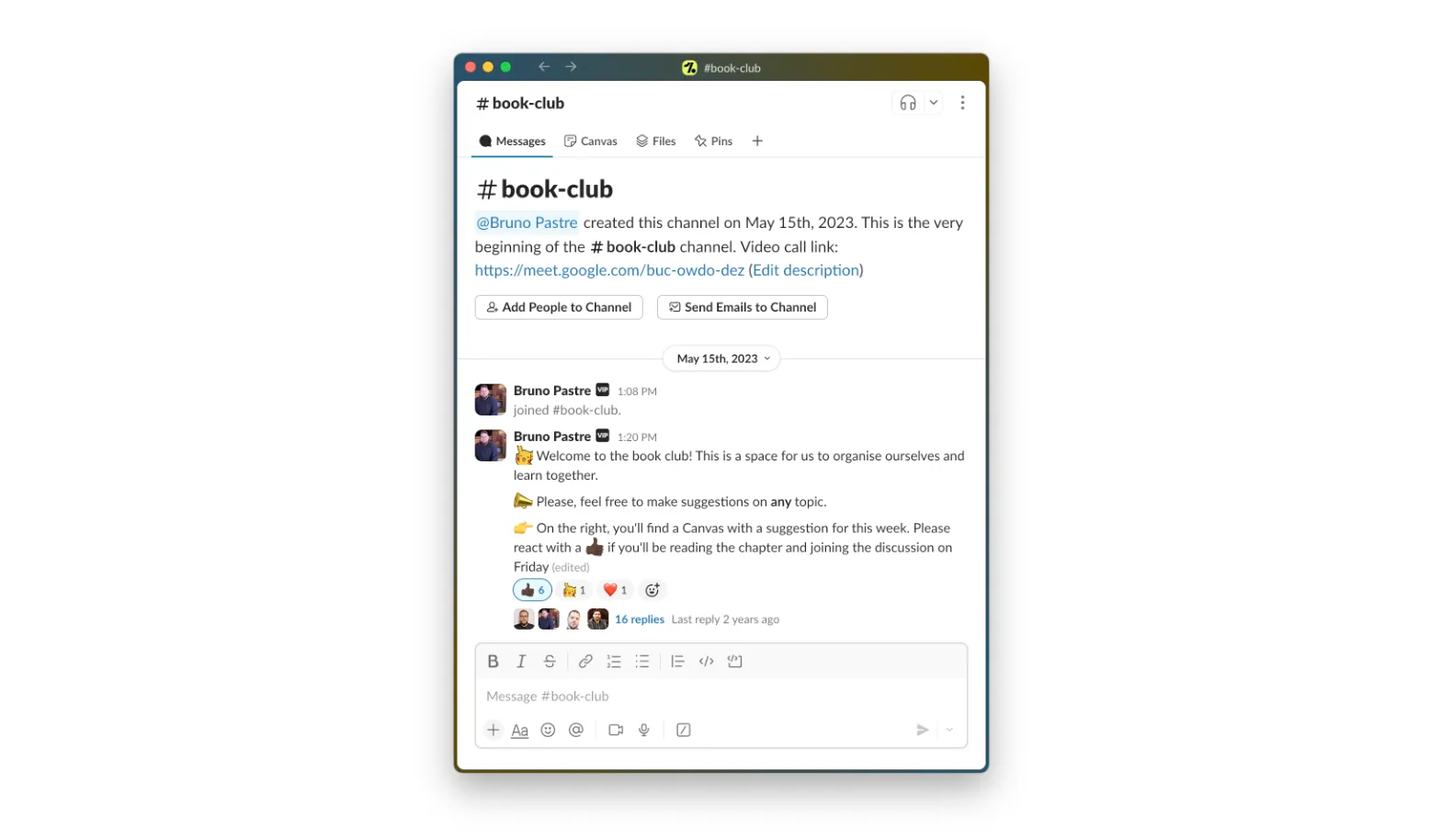
On May 15th (2023), exactly two years ago, our #book-club Slack channel was created and a few days later, we had our first meeting. A couple of books and articles later, we are happy to share (and celebrate) this fun and exciting journey.
No boss: a social, community-driven activity
There are no written rules in our book club. Rules are not the best tool to build culture, education is instead. This way, behaviours come out naturally and slowly become practices.
There is also no boss. Everyone participates equally on all rituals. Even when a manager is in the meeting, during that time, they are just one of us. We are a community, and all decisions are made collectively — from choosing what we’ll read next to making official announcements on our Slack channel.
Being in the book club has been an amazing experience! It gives me a sense of belonging to a warm community, where everyone is welcoming to different perspectives. I always look forward to the opportunity to join in and express my ideas with people who are open-minded and eager to discuss. — Mika Salazar
It is really cool to see how the absence of a mediator role also opened up space for others to, even unknowingly, exercise leadership.
For example, many meetings kicked off with Estérfano and his great notes, while many discussions were summarised and wrapped up with Bruno Costa saying, “More of that in the next chapters“.
Without even noticing, we’ve been softly training non-technical skills: sharpening our listening, communication, and organisation.
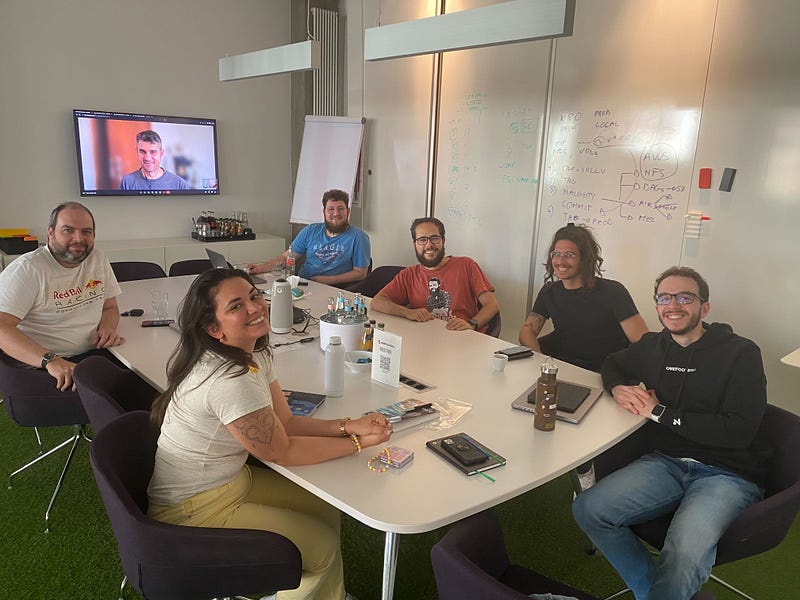
Another important point is that there is no pressure to produce artefacts; they come naturally out of the learning process, which is essential to make the club an enjoyable social activity.
We already have enough deadlines to meet and artefacts to produce throughout the workweek. Creating an environment without any pressure, where the only expectations are to listen and contribute to an engaging, relaxing, and meaningful discussion, is priceless. That’s the breeding ground for learning excellence.
I can learn and hold new concepts much faster and for much longer when I do it collaboratively, talking with other people and validating experiences with each other. The book club was the perfect place for that, and every time I participated I could share experiences, materialize concepts and learn new stuff that wasn’t quite obvious. — Brenno Costa
Book chapters as a starting point
Nearly every discussion in our book club starts with the theory proposed by a given chapter and ends up covering a broad range of examples from our daily challenges at work.
There is no rush to finish a book. We understand the value of the discussion and let it takes its time.
In the end, the learning from the book chapter to be discussed became a starting point for even deeper discussions — Estérfano Lopes
Even those who haven’t read the material beforehand are encouraged to join the group. We all know that life happens, and, sometimes, we are unable to read the chapter before the Sharing Time. That’s totally fine. This person’s experience enriches the discussion and they usually end up taking something valuable from what they hear from others.
In the end, the topics brought by a chapter are naturally connected to generative themes, which act as dialog drivers on our discussions.
What I really enjoy about the book club is that with every topic we explore through reading, we also share our own real-world experiences and perspectives. For me, it’s a powerful way to reflect on and re-evaluate our values at work. — Amir Jelodari
Generative themes are the key issues and concerns that shape a society at a given time. As a microcosm of society, with our own (engineering) culture, it’s important to acknowledge and embrace these themes. By understanding them, we can shape learning experiences that are relevant to people’s jobs (and lives).
Building a learning culture
Software development is a process of discovery and exploration. Therefore, in order to succeed at it, software engineers need to become experts at learning.
Most of the time, however, taking a moment of deep focus on a specific topic is a bit hard. There’s always a new feature to deliver, an issue to investigate, or a last-minute meeting to attend, all of which ends up taking priority over our learning plans.
In addition, reading is a dying habit. Most people are not used to picking up a whole book and reading it from start to finish. Specially a technical one. This makes it harder to grasp deeper concepts, which require a well-defined thread of reasoning in order to be truly understood.
Having an official meeting, every other week, with a clear scope to be read and discussed, helps us stay engaged and maintain (or even build from scratch) a consistent learning habit.
Thanks to the book club, I find myself reading more, which is something I’m not used to, so naturally, it is challenging me to become a better engineer — Mika Salazar
Since the meetings’ discussions are so engaging and so connected to our daily work, it’s not uncommon for us to read the material afterward (in case we haven’t had a chance to read it beforehand) or seek out other sources to deepen our learning.
An organisation’s culture is built on habits. With regular and engaging habits, such as the Book Club meetings, a learning culture can organically emerge.
Consistency is key
No matter what, whatever happens, come rain or shine, there will be a 60-to-90 minutes book club meeting every other week. We call them Sharing Time.
Although that might not sound enough to make significant progress, over time, consistency wins the race. It takes a while to finish a book, but, after two years, we are able to see how far we’ve come and how much knowledge we’ve acquired.
Having a specific topic every other week to discuss with other professionals made me eager to learn more and contribute to the discussion […] I learned a lot, and it proved to me that this is the best place for knowledge sharing and community/culture building in an engineering team — Estérfano Lopes
Slow and steady, we’ve done quite a lot.
In the last two years we’ve read books and articles around DevOps, scientific method, observability, test in production, engineering principles, and much more.
So far, we’ve read the following materials:
- Accelerate, by Nicole Forsgren, Jez Humble, and Gene Kim
- Observability Engineering, by Charity Majors, Liz Fong-Jones, and George Miranda
- The Testing Distributed Systems series, by Cindy Sridharan (Testing Microservices, the sane way, Testing in Production, the safe way, and Testing in Production, the hard parts)
- Modern Software Engineering, by David Farley
It’s been a long and rewarding journey. And it gets even better when we look back and start to connect the dots.
Connecting the dots
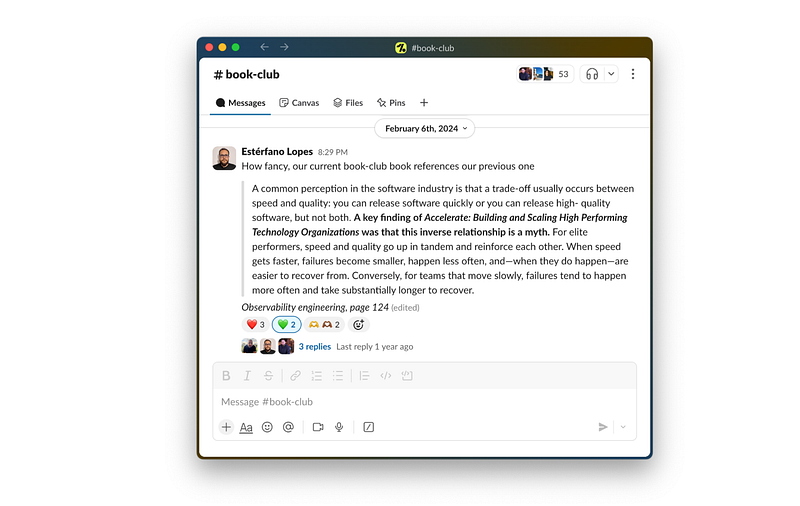
Looking back, it’s amazing to see how things gradually started to come together, and how, brick by brick, we’ve been able to build a strong foundation for improving both the way we work and our software development practices.
It’s been a great way to grow ideas — whether technical, related to our engineering culture, or even around how we collaborate as a team — and often these ideas end up being applied in our work. — Tiago Rocha
By reading Accelerate and the Testing Distributed Systems series, for example, we were able to push forward on testing in production and adopting better DevOps practices. Throughout this journey, we got rid of staging environments, supported the adoption of Continuous Delivery and our Deployment Pipelines, critically questioned practices, and had insights to understand why some things were not working.
However, the most impactful reading so far has probably been the Observability Engineering book. By reading it, we were able to build a collective knowledge about the topic, shifting from a monitoring mindset to a observability one. In addition, as Bruno Costa pointed out in this observability webinar, the engineers who attended the book club meetings are still the ones recognised company-wide as those with the strongest knowledge on the topic.
[…] You mentioned about the Observability Engineering book. We read it and I think the people that took the most from the learnings, about the concepts, were the people that participated in the book club. You can see, even today, when you discuss the topics, everyone […] that was involved in the book club, they got the idea better; they know, they did the shift left observability […] when they are designing the application, they are thinking about observability all the time, not just putting some SDK that instruments the applications automatically for them. — Bruno Costa (starting at 29:57)
By turning the book club into a consistent habit, grounded in the most relevant content of our industry, we knew that the everything would eventually click, and that valuable outcomes would follow. As Steve Jobs remarkably said, “You can’t connect the dots looking forward; you can only connect them looking backwards.”
We’ve been witnessing that throughout this journey.
Long live the book club!
As the first Slack message shows us, the original intention behind the Book Club was to “organise ourselves and learn together”. However, it became much more than that. In the end, it’s a bi-weekly team building activity and a cultural driver at OneFootball.
Two years later, we’re able to harvest the benefits out of it and to value how many relationships we’ve built along the way.
Overall, it’s a simple but powerful way to help level up as engineers together, while also bringing people closer and creating meaningful, human connections. — Tiago Rocha
[…] it gives us a chance to socialize — just in a more thoughtful, technical way. We should definitely do this more often. In the end, this kind of connection and conversation is what truly matters. — Amir Jelodari
Another thing I like is meeting people with different backgrounds and roles who are in a space to learn something new and help each other. I like the kind of connection being made in the book club. — Alexandre Navarro
This is the summary of two years of our Book Club. More than just knowledge sharing, it’s a social event. It’s probably the best way to close a busy work week.
Long live the book club! 🎉 📚