Getting to know the possibilities (Day 2)
After thinking a lot about what I learned a few days ago and after talking to some friends, I decided to start from the beginning, after all, Rome wasn't built in a day.
So, I took one of the coding challenge I participated a few months ago and tried to implement it with Claude. Actually, I just told him what should be done and waited.
Twenty minutes later, all the three requirements were done. And, to be honest, with a better UX than I was able to deliver in six hours.
👀
Ok. In my defense, it was a very simple example and the code was not as scalable/maintainable as the one I delivered. In addition, it's important to note that Claude's solution didn't implement any test.
However, it was a very impressive result, indeed.
So, I decided the next steps on this knowledge building: (1) make a TDD practitioner agent (and rebuild the same challenge with it) AND (2) make my agent an excellent React code reviewer. The starting point? Nick Tune's open source projects.
Before starting with the AI part, I first set up Playwright to handle our Acceptance Test suite. After adding a simple example, I went back to Claude.
Here, I started by installing Nick Tune's claude-skillz plugin. Then, I ran Claude with the TDD skills, asked it to add characterization tests for the existing features, and to finally implement the required tasks.
It worked reasonable well.
Tests were a bit too attached to the implementation and tokens consumption sky rocked. At some point Claude seemed to become tired and started to change testing code just for the sake of fitting it to the solution. Not the best result, but it was still promising.
There are some points to consider about this experience:
- TDD is a design tool and Claude actually doesn't care too much about the feedback it provides. Perhaps TDD is not the best approach for coding agents, or, maybe, I could achieve a better result if I provided the tests and just asked it to implement the solution... something to try out later
- Tokens are consumed very fast. I tried it in a very small code base, and asked it for clear and simple tasks. A simple back-of-the-envelope calculation makes me wonder how much money I would need to spend in a real world scenario. However, I used Claude with no further configuration and I know there are a few options to deal with it... another something to try out later
In the end, after this session, I noticed myself thinking the same thing Kent Beck realized a few months ago:
 Kent Beck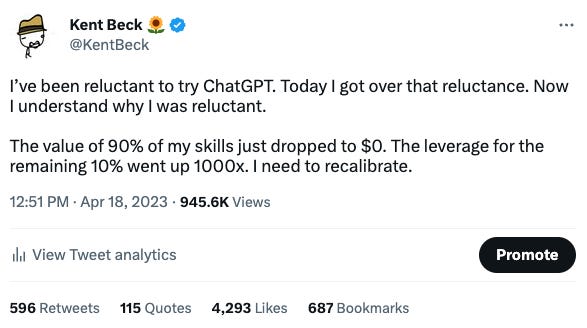
Next step: build a code review buddy.
Interesting contents I read and watched along the way
Here are few other things I found interesting today:
- (Article) Superpowers: How I'm using coding agents in October 2025
- everything-claude-code – The complete collection of Claude Code configs from an Anthropic hackathon winner
- (Video) Clawdbot Review: Is It Actually Worth It?
- (Video) The Only Claude Skills Guide You Need (Beginner to Expert)
- (Article) When to Use Claude Code Skills vs Workflows vs Agents
- (Podcast) Exploring AI Agents Platforms